
Persistent flushing, cheeks that stay red long after a warm room or a glass of wine, thread veins no concealer fully hides, rosacea wears on your confidence as much as your skin. If you have been researching whether IPL treatment for rosacea and redness really works, the honest answer is this: for the vascular signs of rosacea, the diffuse redness and visible vessels, intense pulsed light has strong clinical support. It manages the condition rather than curing it, and how well it works depends on your rosacea subtype and skin type. This guide covers the evidence, how long results last, what to expect, and how IPL compares to laser.
What IPL Is and How It Treats Rosacea Redness
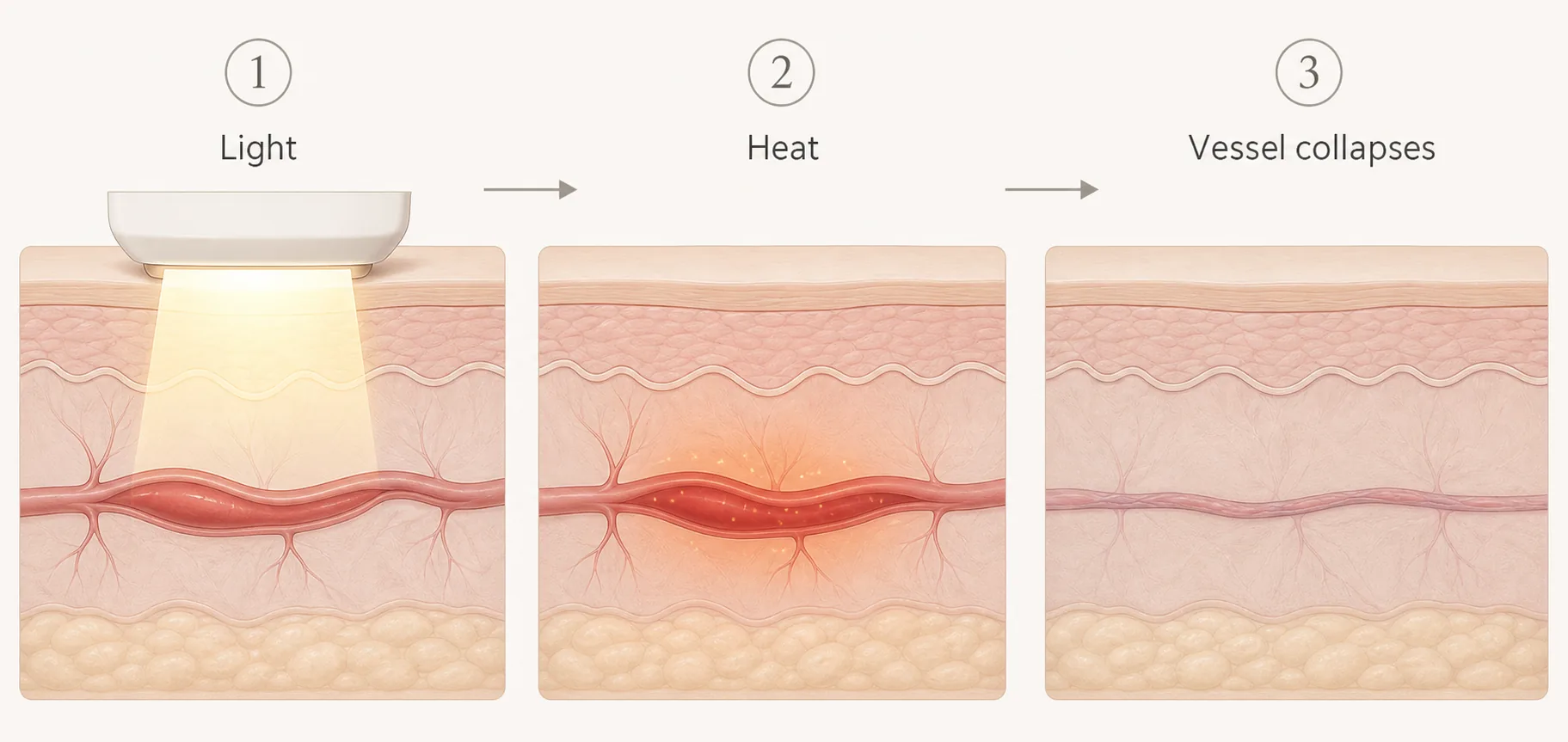
IPL stands for intense pulsed light. Unlike a laser, which emits a single focused wavelength, IPL releases a broad spectrum of light across many wavelengths. Filters narrow that light so the energy targets specific structures in the skin. For rosacea, the target is haemoglobin, the pigment inside the dilated blood vessels driving your redness.
That distinction matters. IPL treats the vascular component of rosacea: the flushing, background redness, and broken capillaries. It is far less suited to the papulopustular subtype, where inflamed bumps and pimples dominate. A proper skin assessment establishes which pattern you have before any light touches your face.
How IPL reduces redness and visible vessels
When the pulsed light reaches a dilated vessel, the haemoglobin absorbs the energy and converts it to controlled heat. That heat damages the vessel wall, causing it to collapse. Over the following days and weeks, your body reabsorbs the treated vessel. The result is fewer visible telangiectasias and a calmer, more even skin tone across the treated area.
IPL for rosacea is a non-surgical, light-based treatment that uses broad-spectrum pulsed light to heat and shrink the dilated blood vessels responsible for facial redness and visible capillaries, reducing the vascular signs of rosacea over a course of sessions.
The American Academy of Dermatology confirms that lasers and light therapies can reduce the redness and visible blood vessels associated with rosacea, while noting that suitability and settings should be judged by a trained professional.
Does IPL Treatment for Rosacea and Redness Actually Work?

For the right candidate, yes. IPL has repeatedly shown high efficacy for vascular rosacea and telangiectasias, particularly in lighter skin types (Fitzpatrick I–III). Most people see improvement across a course of treatments rather than a single session, with redness softening and thread veins fading progressively.
Stay balanced about what that means. IPL reduces the redness and vessels you can see now, and often improves skin comfort and sensitivity, but it does not switch off rosacea’s underlying tendency to flush and form new vessels over time.
Worked wonders for me. Reduced my redness by 80 to 90%. Flushing is basically non existant now. Apparently my skin complexion is perfect for IPL.
What the research says about IPL success rates
The clinical literature is consistent. A study on the treatment of rosacea and telangiectasias using IPL describes IPL as a safe, effective, and versatile option for vascular rosacea lesions in skin types I–III, with skin visibly improved across multiple sessions. Rather than a single “cure rate,” studies report progressive, cumulative improvement: redness reduced, vessels cleared, and satisfaction high when treatment is matched to the right subtype.
So when patients ask about the success rate of IPL for rosacea, the fair answer is that outcomes are strong for vascular redness and visible vessels, more limited for inflammatory bumps, and best predicted by an honest skin assessment before you start.
I’ve had IPL done many times and it helped me a lot. It massively reduced the red veins on my face as well as the diffuse redness on my face. It …
Does IPL Permanently Fix Rosacea?
No. Rosacea is a chronic condition with a genetic and inflammatory basis, and no light-based treatment removes that cause. IPL clears the vessels and redness present today, but your skin keeps its tendency to develop new ones.
This is why maintenance sessions are usually recommended once your initial course is complete. Think of it the way you would manage any long-term skin condition: you keep it well controlled rather than expecting a one-time fix. Handled realistically, that is reassuring, control is achievable, results can be maintained, and many people find their skin far calmer and easier to live with than before.
How Long Do IPL Results for Rosacea Last?
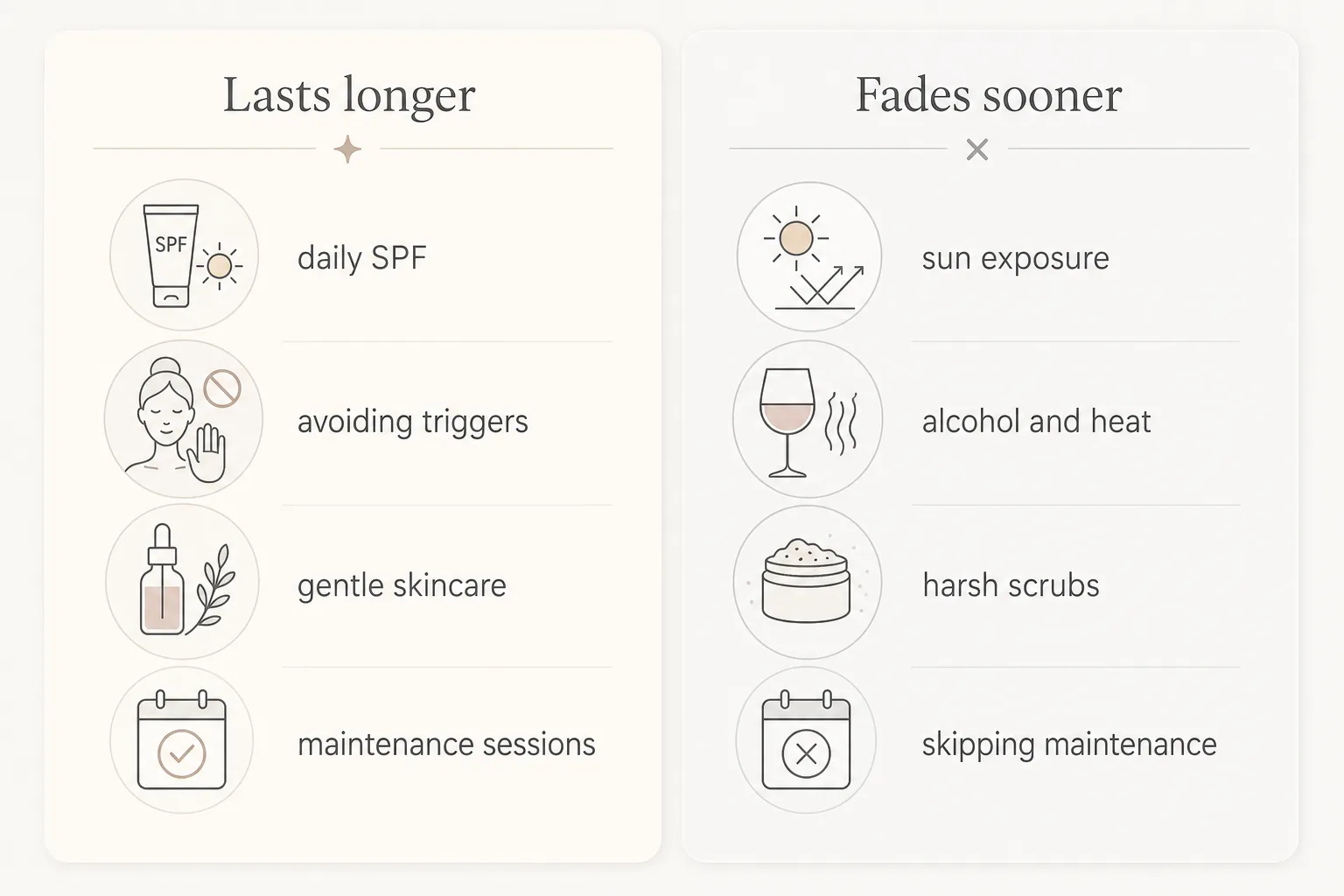
Results build over a course of sessions, and the improvement often holds for many months before a top-up helps. No single number applies to everyone; longevity depends on your skin, your triggers, and how well you protect the results afterwards. Many clinics suggest occasional maintenance treatments spaced across the year to keep redness in check.
What affects how long your results last
Several factors push your results in either direction:
| Factors that extend IPL results | Factors that shorten IPL results |
|---|---|
| Diligent daily sun protection (SPF) | Frequent unprotected sun exposure |
| Identifying and avoiding personal triggers | Regular alcohol, heat, or spicy-food triggers |
| Gentle, barrier-supporting skincare | Harsh, over-exfoliating routines |
| Milder, well-controlled rosacea | More severe or rapidly progressing rosacea |
| Scheduled maintenance sessions | Skipping maintenance after the initial course |
| Managing flushing and stress | Smoking and high daily stress levels |
Sun exposure is the single biggest variable. Ultraviolet light both worsens rosacea and shortens how long your IPL results last, which is why daily SPF is non-negotiable after treatment.
What to Expect During and After IPL Treatment
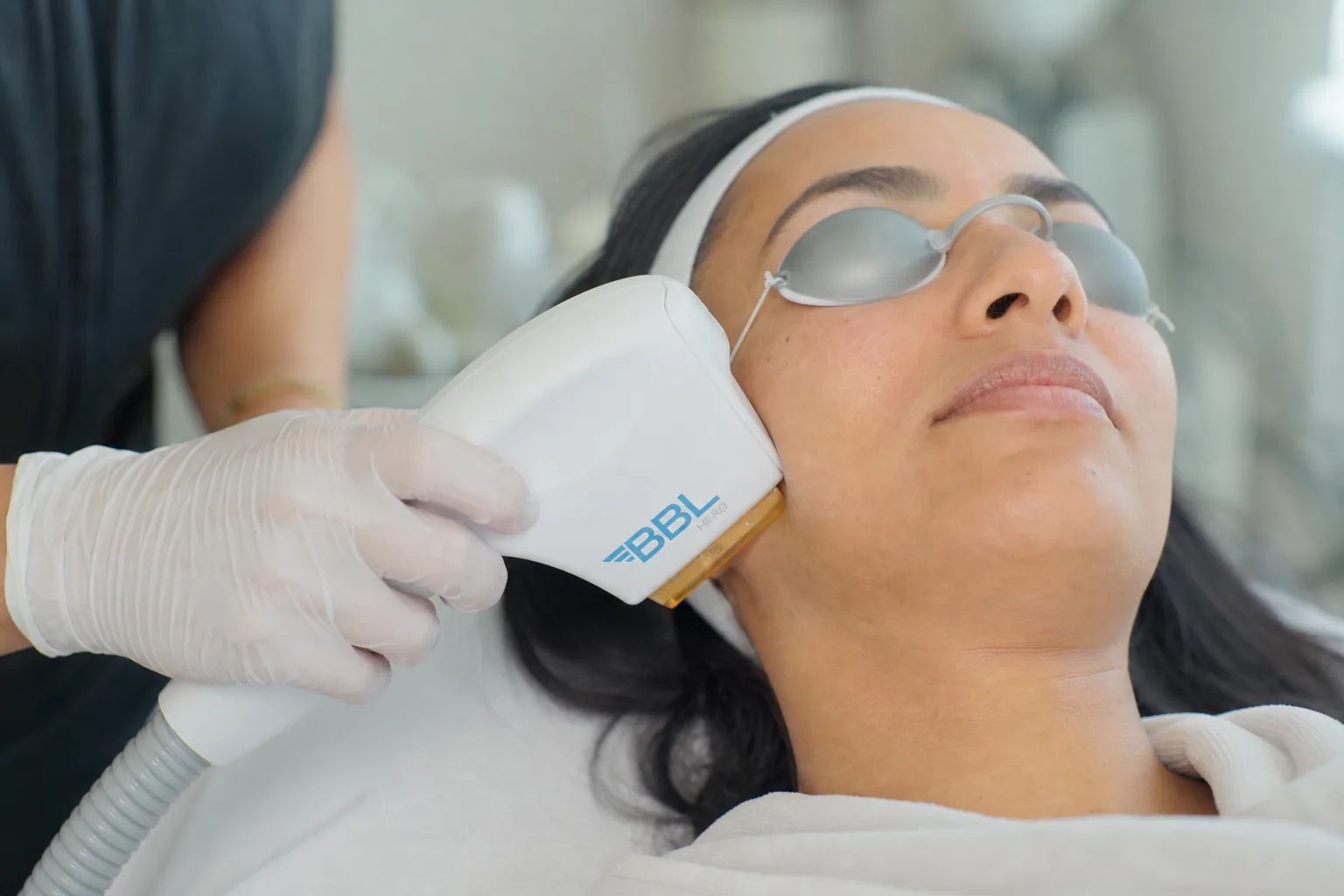
Knowing the process removes most of the anxiety around it. A typical rosacea course involves several sessions spaced a few weeks apart, letting your skin respond and recover between visits.
During the session
A cool gel is usually applied to the treatment area, and you wear protective eyewear. As each pulse fires, most people describe a light snap, a bit like a warm elastic band flicked against the skin, followed by brief warmth. Sessions are quick, often 20 to 30 minutes for the face, and no anaesthetic is generally needed.
After your IPL photofacial
Mild redness and a warm, slightly flushed feeling are normal for a few hours to a day or two. Treated vessels may briefly look darker before fading, and any surface pigment can take on a temporary “coffee-ground” darkening that flakes away over the following week. Downtime is minimal, most people return to normal activities the same day, but your skin will be more light-sensitive. Diligent sun protection is essential, and the American Academy of Dermatology’s guidance on lasers and lights for rosacea reinforces how central sun avoidance is to a lasting outcome. Avoid heat, hot showers, saunas, and vigorous exercise for the first 24 to 48 hours to keep flushing down.
Why Is My Rosacea Worse After IPL?
A short-lived increase in redness immediately after treatment is expected and settles quickly. A genuine flare, worsening that persists or spreads, is different, and usually points to something avoidable.
Common causes include incorrect device settings, treating the wrong subtype (using IPL on inflammatory, bump-dominant rosacea rather than vascular redness), inadequate skin cooling, treatment carried out during an active flare, or an operator without the training to read your skin. Rosacea skin is reactive by nature, so precision matters.
This is exactly why practitioner skill and a thorough skin assessment are not optional extras. A responsible clinic patch tests, screens your subtype and skin type, and adjusts settings to your individual skin rather than applying a one-size-fits-all protocol. A proper cosmetic skin consultation before treatment is the best safeguard against a poor reaction.
IPL vs Laser and Other Rosacea Treatments
IPL is one of several evidence-based options, and the best choice depends on what your rosacea actually looks like.
| Treatment | Best for | Redness type addressed | Considerations |
|---|---|---|---|
| IPL (intense pulsed light) | Diffuse background redness plus visible vessels | Broad flushing and telangiectasias | Minimal downtime; best on lighter skin types |
| Vascular laser (e.g. pulsed-dye or Nd:YAG) | More prominent or larger individual vessels | Focused, defined vessels | Can target deeper or stubborn vessels; may bruise |
| Topical and oral medical management | Inflammatory bumps and pustules | Papulopustular rosacea | Managed via prescription; treats inflammation, not vessels |
| Skincare and trigger management | All subtypes as a foundation | Overall redness resilience | Supports every other treatment; slow on its own |
Both IPL and vascular lasers reduce redness and visible vessels, and research on the treatment of rosacea and other vascular lesions using light-based devices supports their role. The most suitable option comes down to the pattern of your redness, your skin type, and your tolerance for downtime.
Which treatment is most successful for rosacea?
There is no single winner, because rosacea is not a single condition. The most successful approach is usually a combination: a light-based treatment such as IPL for diffuse redness and vessels, medical or topical management for any inflammatory component, and consistent trigger control and skincare underpinning it all. IPL is strongest where redness is broad and vessels are visible, the picture most people have in mind when they think of rosacea.
Is IPL Right for Your Skin? Suitability and Skin Type
The best candidates for IPL have erythematotelangiectatic rosacea, the redness-and-vessel subtype, and lighter skin tones in the Fitzpatrick I–III range, where the light can safely distinguish vessels from surrounding skin.
IPL is approached with more caution, or avoided, in several situations: darker skin tones (where the light can affect surrounding pigment), active skin infection, a recent tan or sun exposure, pregnancy, and certain photosensitising medications. None of these are simple yes-or-no rules, they are the details a personalised assessment exists to weigh. This is where individualised treatment planning earns its place, matching the technology to your skin rather than fitting your skin to the technology. For some people, IPL sits alongside the other skin rejuvenation and advanced facial treatments an aesthetic skin clinic in Guernsey may offer as part of a longer-term skin-health plan.
Can You Do IPL for Rosacea at Home?
At-home IPL devices exist, but they are not equivalent to clinical treatment for rosacea. They are lower-powered, largely calibrated for hair removal, and lack the filters, cooling, and adjustable settings a professional device uses to target facial vessels safely.
Used on reactive rosacea skin without proper assessment, a home device can aggravate redness rather than reduce it, and there is no clinician there to read your response or adjust the approach. For a condition as individual and easily inflamed as rosacea, in-clinic, medically supervised IPL is both the safer and the more effective route.
Frequently asked questions
Does IPL permanently fix rosacea?
How many IPL sessions are needed for rosacea?
Is IPL treatment for rosacea painful?
Can IPL make rosacea worse?
How soon will I see results after IPL?
Three sessions is the average for the first round of most IPL treatments. I had three done originally about 20 years ago and have had two one- …
Key Takeaway
IPL is an effective, evidence-supported option for the redness and visible vessels of rosacea, but it manages the condition rather than curing it. It works best on lighter skin types with vascular-pattern rosacea, delivers results gradually across a course of sessions, and depends heavily on an accurate skin assessment and a skilled practitioner.
