
The difference between skin boosters and dermal fillers is a difference of purpose, not ingredient. Both are hyaluronic acid injectables. Skin boosters improve hydration and skin quality across an area; dermal fillers restore volume, lift and contour in one place.
That shared ingredient is why the two get confused. The same molecule is engineered in two ways, and the engineering decides the result.
The useful question is what your skin has actually lost. Dull, dry, crepey skin is a quality problem. A flattened cheek or a softening jawline is a structural one.
What skin boosters do to the skin
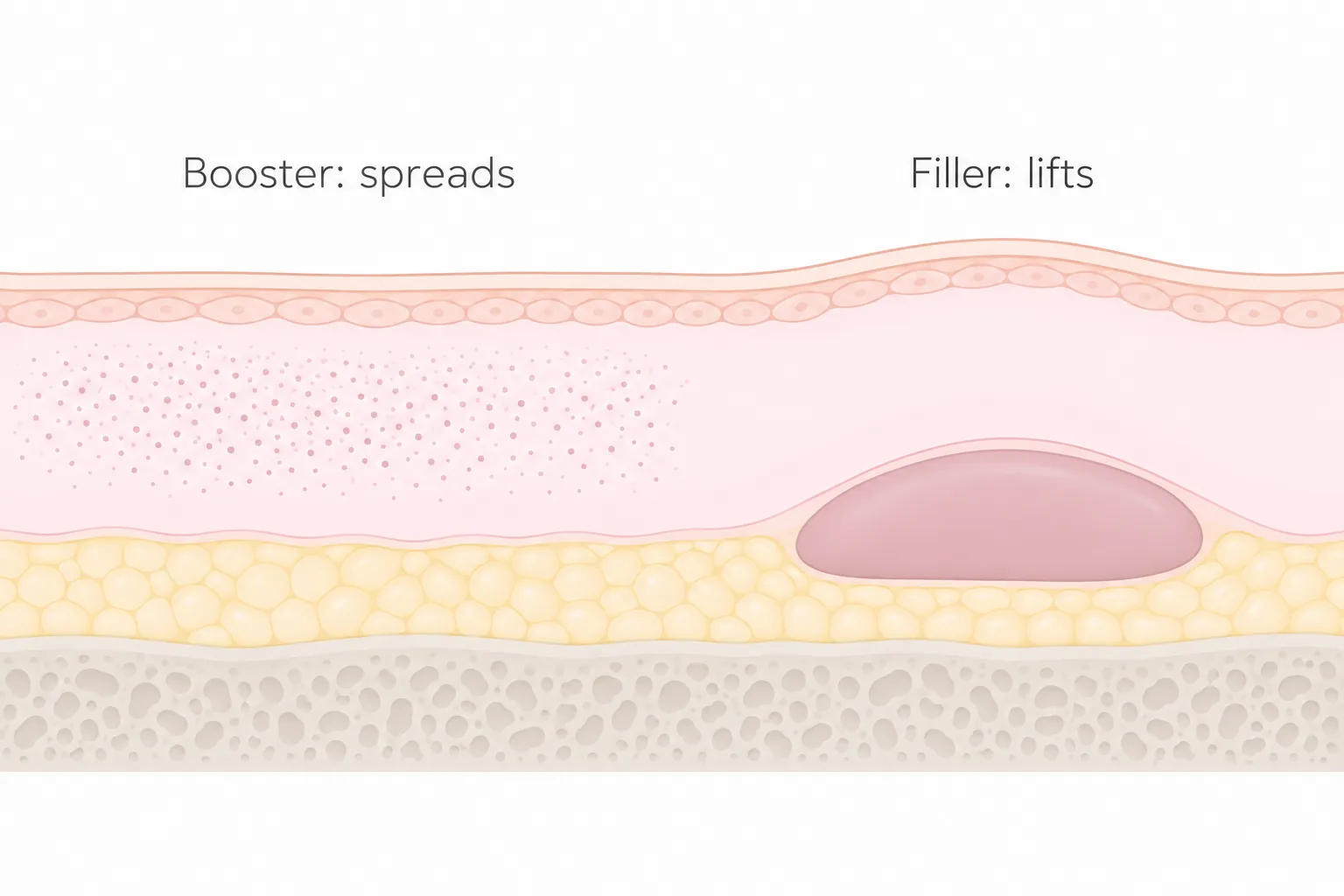
Skin boosters use soft hyaluronic acid that is either non-cross-linked or only lightly stabilised. The gel is made to spread through tissue rather than hold a shape.
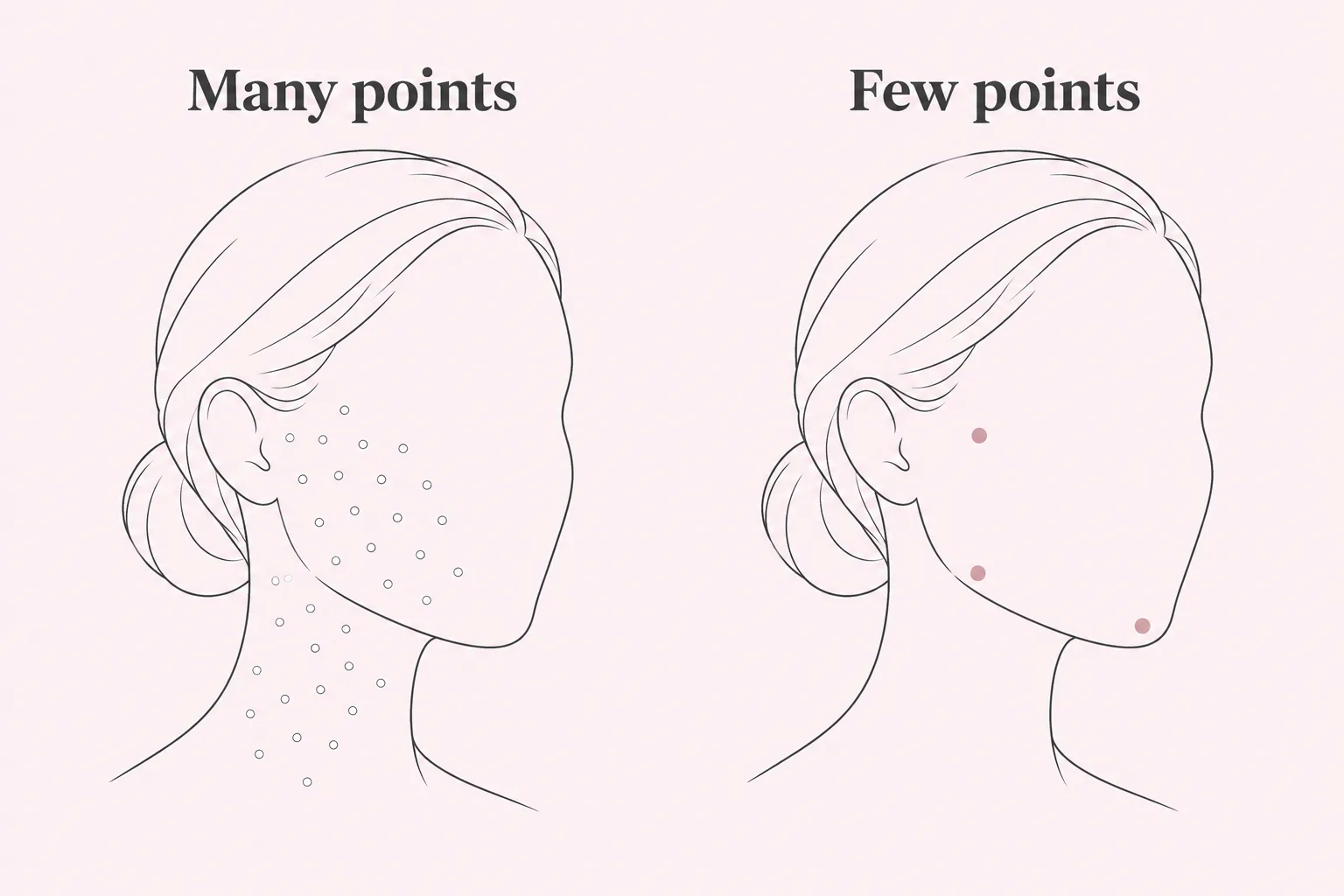
They are delivered as a series of micro-injections spaced across an area: cheeks, neck, décolletage or the backs of the hands. Coverage matters more than any single injection point.
The targets are dehydration, fine crepey lines, dull tone and rough skin texture. Attracting and holding water in the dermis is the primary mechanism.
Boosters are also intended to encourage fibroblast activity, which is the reasoning behind treating in a course rather than one session. Most protocols run two to three sessions a few weeks apart, then maintenance.
What boosters do not do is change your face shape. This is skin rejuvenation therapy, not facial balancing.
What dermal fillers do differently
Dermal fillers use cross-linked hyaluronic acid gel with genuine lift capacity. The gel resists compression, so it can support tissue and project a contour.
Placement is deeper and more precise, using fewer injection points. Fillers treat volume loss: mid-face flattening, hollow temples, jawline definition, chin projection, lips and deeper folds. For more noticeable lower-face laxity, other non-surgical facelift options for sagging jowls may also be considered depending on the cause of the sagging.
Results are visible immediately, then settle over roughly two weeks as swelling resolves and the product integrates.
Natural-looking results come from assessment and restraint, not from the volume of product. Fillers sit alongside other injectable aesthetics, including wrinkle-reducing injectables, which soften movement lines rather than replace lost structure.
Difference between skin boosters and dermal fillers at a glance
| Aspect | Skin boosters | Dermal fillers |
|---|---|---|
| Primary goal | Hydration, tone, skin texture improvement | Volume, lift, contour, definition |
| Formulation | Soft, non- or lightly cross-linked HA | Firmer, cross-linked HA gel |
| Injection depth | Intradermal to superficial subdermal | Deep dermal, supraperiosteal or deeper planes |
| Technique | Many micro-injections across an area | Few targeted points |
| Common areas | Face, neck, décolletage, hands | Cheeks, temples, jawline, chin, lips, folds |
| Visible result | Gradual, over several weeks | Immediate, settling in about two weeks |
| Effect on face shape | None | Deliberate change to contour |
| Structure | Course of sessions, then maintenance | Single treatment, reviewed and topped up |
| Downtime | Small bumps usually settling in 24 to 48 hours | Swelling and possible bruising |
Injection depth, spread and why formulation dictates the result
Cross-linking density explains most of the gap. More cross-linking means more lift and slower breakdown by the body.
Boosters are built to disperse. Fillers are built to stay where they are placed and hold weight above them.
Depth follows function. A booster placed too deep loses its effect on surface quality, and a filler placed too superficially can look lumpy or blue-tinged.
How long each lasts and what maintenance looks like
Skin boosters are shorter-lived. Most patients treat them as a routine, repeating a short course a few times a year.
Fillers last considerably longer, though how long depends on the product used and the area treated. Mobile areas break product down faster, so lips generally need refreshing sooner than cheekbones.
A practical way to budget: boosters are an ongoing habit; fillers are a periodic intervention. Both hold up better when supported by professional skincare and daily sun protection.
Safety, risks and what to ask before treatment
Both treatments share risks: bruising, swelling, tenderness, infection and, less commonly, nodules.
Fillers carry one risk boosters largely do not. Vascular occlusion, where product obstructs a blood vessel, is rare but serious. It is the reason injector training and facial anatomy knowledge matter more than the brand of product.
One advantage of hyaluronic acid over permanent materials is reversibility. HA can be broken down with hyaluronidase, an enzyme practitioners keep on hand for corrections and emergencies.
So are skin boosters safer than fillers? Their structural risk profile is lower, largely because they are placed superficially in small volumes. Lower risk is not no risk.
Cosmetic injectables are adult-only treatments, and a responsible clinic will decline anyone under 18 who asks for them on cosmetic grounds. Expect a face-to-face medical assessment and written consent.
Some patients are stepping away from fillers altogether, usually after overfilling, product migration or a shift in preference towards skin-quality treatments. That is a legitimate choice, and it is part of why boosters have grown so quickly.
The difference between skin boosters and dermal fillers for older skin
Let the concern decide. Dull, dry, crepey skin with poor light reflection points towards boosters. Hollowing, flattening and a softening facial outline point towards fillers.
Mature skin often needs both, and sequence matters. Restoring support first means the skin sits correctly before surface work begins.
There is no single best filler for older skin. Product choice depends on the area, tissue laxity and how much support is needed, which is assessed individually rather than picked from a list.
Sometimes neither is the answer. Pigmentation, active acne or reactive skin may respond better to a chemical peel for sensitive skin, medical-grade facials or laser treatment.
Combining both: structure first, then skin quality
Combined plans work best when spaced sensibly. Volume is usually addressed first, then boosters refine texture and luminosity once the foundation has settled.
Boosters also pair well with wrinkle-reducing injectables, SofWave for skin tightening, and collagen-stimulating resurfacing.
This is the work behind the glass skin facial trend. The Korean glass skin look is light reflecting off well-hydrated, smooth skin, so it comes from skin quality, not volume.
Worth saying honestly: glass skin is achievable as improved luminosity, maintained over time. It is not a permanent finish, and no single session delivers it.
Other supportive treatments, such as LED light therapy for the skin, may also be incorporated into a broader skin-quality plan depending on the individual’s needs.
What a consultation at an aesthetic skin clinic involves
A thorough consultation starts with skin assessment, medical history, medication review and allergy checks.
Your practitioner should assess your face at rest and in movement before selecting any product, then discuss goals, budget and realistic outcomes, including what the treatment will not achieve.
Aftercare guidance and a review appointment should be standard, not optional extras.
At Guernsey Medi Spa, treatments are planned in a medical-grade setting with a bias towards natural results and personalised treatment plans. If you are unsure which route suits your skin, start with a skin consultation.
Frequently asked questions
Is a skin booster better than a filler?
Are skin boosters really worth it?
Can I have skin boosters and dermal fillers at the same appointment?
Do skin boosters change the shape of my face?
How soon will I see results?
Key takeaway: match the treatment to the concern
Boosters are for skin quality and hydration. Fillers are for structure and contour.
Same ingredient, different engineering, different outcome.
The right choice comes from an honest assessment of what your skin has lost, not from what is trending online.
